

1️⃣Draw.io: A free web-based diagramming tool that provides researchers with a wide range of shapes, symbols, and connectors for creating flowcharts, concept maps, and other visual representations.
https://app.diagrams.net/
2️⃣Krita: A free and open-source digital painting software that provides researchers with advanced drawing tools, including brushes, layers, and blending modes, for creating detailed and realistic illustrations or artworks.
https://krita.org/en/
3️⃣Sumopaint: A free online image editing tool that provides researchers and students with a wide range of drawing tools, filters, and effects, making it suitable for creating and editing digital images, diagrams, or illustrations.
https://sumo.app/
4️⃣GIMP is a free and open-source raster graphics editor with extensive tools, layers, filters, and extensibility. Popular for image editing, compositing, and visual enhancements among researchers, artists, and designers.
https://www.gimp.org/
5️⃣Edrawsoft.com offers a diverse range of diagramming software solutions for various industries, including flowcharts, mind maps, org charts, and more. It’s user-friendly, versatile, and provides professional results for visual communication needs.
https://www.edrawsoft.com/
Author: anwesa
Top Picked #AI Tools 🚀 for Ph.D. Students/Researchers 🎓 in 2023
✅ Research rabbit
It visualizes the network of interconnected research papers on a particular topic from various authors. The AI tool learns the research interest of the user and generates new recommendations.
https://lnkd.in/dxMqUN8v
✅ ChatPDF
The AI tool analyses your research paper and answers the questions you need.
https://www.chatpdf.com/
✅ Writefull
A team of PhDs in AI and linguistics created Writefull .
It provides language feedback and a set of writing tools, such as an automated Paraphraser, Abstract Generator, Title Generator, Academizer, a database of academic texts (Language Search), and a collection of example sentences (Sentence Palette).
https://www.writefull.com/
✅ Humata
It transforms complex technical papers into concise explanations. It answers the queries regarding the article. It generates detailed insights for reports, papers, etc.
https://www.humata.ai/
✅ Explainpaper
It allows the researcher to upload a paper highlighting confusing texts/formulas. Then, it gets an explanation.
https://lnkd.in/dB5TYm4d
✅ Teach Anything
Teach Anything is an innovative research software designed on GPT-3 technology that can help users find answers to any questions.
https://lnkd.in/d_fuikTj
✅ BioRender
It is an online AI tool for creating, editing, and collaborating on scientific illustrations and diagrams. It provides over 40,000 icons for developing scientific posters, presentations, publications, etc.
https://www.biorender.com/
✅ Scite
It enables users to see how a publication has been cited by displaying the context of the citation and a classification indicating whether the source provides supporting or contradictory evidence for the cited claim.
https://scite.ai/
✅ Scispace
It highlights confusing text, math, and tables to get a simple explanation
The researchers can ask follow-up questions and get instant answers.
The users can search and find relevant papers without specifying keywords.
https://scispace.com/
✅ Bearly
It is an AI assistant that can assist you in generating creative content, artwork, copy, and edits, among other things. It is the ideal instrument for any individual seeking to create engaging and original content. It employs sophisticated artificial intelligence to facilitate the generation of novel ideas and content that stands out from the crowd. From copywriting to graphic design, it can assist with creating content.
https://bearly.ai/
A weekend getaway in Mainpat
We took a weekend trip to Mainpat, also known as Shimla of Chhattisgarh or the mini Tibet situated in the district of Surguja, Chhattisgarh. It is a beautiful hill station with astounding places like Ulta Paani (Reverse flow of water stream), Jaljali (a place where the land bounces), spectacular waterfalls, and alluring lush green valleys. The site is called mini Tibet because of the Tibetan settlement with seven camps and around 2000 Tibetan staying within it. We started our trip by visiting Jaljali.


Jaljali: The bouncing grassland
This was the first time of me seeing this kind of area where the ground bounces like a trampoline when jumping across it. To start with the description, as we entered the main gate, stairs were going downhill, leading to a grassy meadow with forest on either side of it. The view of Eden green grasses backed with shady dense woods and mules roaming across the fence with the cold bite of wind was enchanting. Jumping above the grassland feels like jumping above a trampoline. Though the intensity of bouncing is not that big, it is undoubtedly a fantastic experience. After researching on the internet, I learned that the grassland is formed on a crater created by a volcano million years ago. The crater, after being filled with rain water and bog plants including mosses, shrubs, aquatic animals, sand, etc., for years, has resulted in a soft land. There is this area where tourists can be seen riding mules across the field. After returning from the site, we came across the local food stalls selling roasted corns and noodles in front of the entrance gate. It has been raining on and off all day. The sky was tar-black, and the car’s roof sprayed with the rainwater was creating a murmuring sound in the ears. The scenery of rolling hills in the evening with the water dripping from the sky was a feast to the eyes.
Afterwards, we had some evening snacks in a Tibetan restaurant called Tashi-lha kitchen and then returned to our stay. On the following day, we started our trip with a visit to Tiger point.


Tiger point
The name comes from the fact that the tiger used to come to the area for drinking water before. As we explored more in that area, we could see there were stairs around 200 in numbers going downhill. As we were going down the stairs, a humming sound was vibrating across the air. There were woods across one side of the stairs, and monkeys were seen jumping across the trees. As we approached more, we saw a waterfall plunging down the wrinkled face of the mountain and gushing over the rocks. Then we walked along the edges of the rocks to reach to the bottom of the waterfall. We sat on a big rock for a while, enjoying the scenic view of a waterfall around 60m in height with the thundering sound toppling into the pool at the bottom. Then, we started heading towards a place called Mehta viewpoint. That day also, the rain was pouring on and off. It was a pleasant weather for travelling.


Mehta viewpoint
This is a place with a higher altitude, thus giving an ethereal view of the majestic mountain range, blooming meadow with wildflowers and bright blue sky. The viewpoint has swings and food stalls inside the premise. Then we started moving towards Dhakpo Monastery.


Dhakpo Monastery
Mainpat is home to around 2000 Tibetans practicing Buddhism in the region. A number of monasteries can be seen across Mainpat, hence named mini Tibet. Dhakpo Monastery is one of the monasteries present across it. It has a beautiful and peaceful surroundings. After the visit, we went to have some food from a Tibetan restaurant called Karma house and restaurant. It has a shop beside the restaurant where prayer flags, idols, Tibetan jewelry, crafts, textiles, etc., can be brought. Next, we started moving towards an astonishing place called Ulta Paani.


Ulta Paani
As we approached the place, the water stream looked like a blue satin of thread across the mountain. As we came closer to the stream of water, we could see the water was flowing backward or flowing uphill. Another strange thing that we observed was that the vehicle was defying gravity. We stopped the car, set the gear to neutral, and released the brake, and the car was moving uphill. This is because the place is a gravity hill or magnetic hill. This place creates an optical illusion where the downhill slope seems to be uphill. The surrounding has such a layout that it develops an illusion and the water & the vehicle, which actually moves downhill, appears to move uphill.


Afterward, we headed towards the Buddhist monastery in camp number 1, the oldest monastery in the Mainpat. It has a giant prayer wheel on the premise. It has tranquil and beautiful surroundings.
Next, we went for a drive across the Mainpat village. With that, we ended our two-day trip and started heading towards the home in the evening.
The trip was amazing and one of my best trips so far.


Bhima Bhoi peetha: an empty shrine
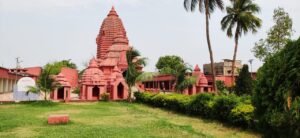
In April, my family and I travelled to Bhima Bhoi Peetha, a temple in a village named Khaliapali, nearly 30 KM from Sonepur. Bhima Bhoi was a poet, saint, philosopher, and preacher of Mahima Dharma. Mahima Dharma opposes idol worship and hence, worships void or shunya as a divine principle. Hence, the temple contains no idols. Mortal remains of the poet are interred in the shrine, and a number of his written works are also available in the museum. Many practitioners of Mahima Dharma can be seen staying inside the temple premise. The temple has a very calm and tranquil environment. Overall, It was a wonderful visit to the temple.


A pleasant boat ride on a summer evening
One summer evening in May, my parents, my sister, and I went on a boat ride in Sonepur. We were sailing from Rameshwar temple to Lankeswari temple in the Mahanadi river. Sailing in the summer evening with a cool breeze flowing was a wonderful experience. The views of fishermen catching fish, people swimming in the evening after work, and birds flying around were breathtaking. We started sailing from Rameshwar temple, a Shaiva peetha built around the 18th century AD on the bank of river Mahanadi.


Along with Lord Shiva, Lord Kartik, Ganesh, and Goddesses Parvati are worshipped there. Then we sailed to the Lankeswari temple on the hillock of river Mahanadi. It is believed that the mighty Raavan had placed Maa Lankeswari idol at Sonepur by bringing it from Lanka. The sunset view from there was mesmerizing.


Kodaikanal: The princess of hill stations
During the month of December 2021, I visited the hill station Kodaikanal located in the Dindigul district of Tamil Nadu. In Tamil, Kodaikanal means the “gift of the forest.” It is situated at an elevation of 7000 feet above sea level along the apex of the Palani Hills. In the mid-19th century, British missionaries used Kodaikanal as their summer capital. We reached there in the early morning.

Firstly, we started with the visit to Kurinji Andavar temple. The temple is nearly 4-5 km from the bus stand and is around 3 km from the Kodai lake. There is this interesting fact associated with the name of the temple that we got to know from the locals. Kurinji is a flower that blossoms once in 12 years, and its tree is there in the temple premise and hence famed with this name. This temple devoted to Lord Murugan was built by a European lady who got to the Hindu religion and started practicing it.


Next, we went to the Moir point, named after engineer Thomas Moir who led the foundation to Goschen road/Forty-mile road which connects Kodaikanal- Berijam lake there. When we reached, it was pretty crowded. The place is filled with fog and provides a splendid view of peaks and valleys. There is a watchtower that offers a fantastic view of the surroundings. Next, a pillar is there, which was built as a memory for the opening of the Goschen road. There is this small park that has a decent place for sitting and enjoying nature’s view and few shops at this location.


Next, we went to the pine forest located southwest of Kodaikanal. It provides an amazing surrounding for long walks and photography. With dried pine cones scattered on the ground and the pine trees seeming to touch the sky, this place is indeed a dream escape.


After that, we went to the pillar rocks viewpoint known for its picturesque beauty. The pillar rocks consist of three giant rocks of around 400 feet in height with a scenic view of fog-clad greenery. The viewpoint has a mini garden with beautiful flowers and a mini-market providing local delicacies outside.
On the next day, we started with the visit to the green valleys. The place, also known as the suicide point, offers an enchanting view of plains and valleys. Several monkeys could be seen jumping around the site. At the entrance, there are a few shops for chocolate, dried fruits, ornaments, and ayurvedic products.

Next, we visited Coaker’s walk, a pedestrian path of around one km providing views of valleys and the city from it. It was constructed by Lt. Coaker in 1872 and hence named after him. It is an excellent place for photography enthusiasts. There are vendors selling ice creams and other food delicacies, jewelry, and woolen garments on the pathways.


Alleppy: The houseboat paradise
Alappuzha, aka Alleppy, is a city located nearly 55 km from Kochi in the south Indian state of Kerala. My husband and I landed in the morning hours of late December 2021 at Alleppy. This was my first time traveling to Kerala. We started heading to a homestay to freshen up in the morning. The pavement to the roadways was filled with coconut trees. After staying there for a bit, we went to the houseboat arena.


A number of houseboats floating in the backwaters is a treat to the eyes. We got to know from the locals that there are more than two thousand houseboats anchored there in the backwaters of Alleppy. Then, we started cruising through the backwaters of Alleppy in the houseboat. Gliding with the views of lush green paddy fields, coconut trees, birds, and bent mangroves was a magnificent experience.


The houseboat was manned by an oarsman and a cook. The staff served us delicious local Kerala cuisine for lunch. We went to a local market, where the houseboat halted for a while. People were buying prawns and crabs from there. Then we started cruising again. The houseboat was equipped with facilities for the night stay. Then in the morning, we started sailing again and finally ended our journey with a breakfast on the houseboat.

The next day we went there kayaking. There were around 15 people gathered for kayaking. We started our journey from there with a guide giving instructions meanwhile. The sight of sunrise from the backwaters was mesmerizing. We went kayaking for around two hours which was a bit exhausting. But again, it was a memorable experience. In the end, I can say the two days travel to Alleppy was worthwhile.
Non fungible token (NFT)
What is it?
The term NFT stands for non-fungible token. Non fungible means something that is not interchangeable. Let’s assume, you have a two hundred rupees note and you are exchanging it with somebody for 2, 100 rupees note. Here, as we can see the currencies are fungible/interchangeable.


Let’s give an example here. Arya creates an album of songs and wants to upload it online. However, she fears her work may get tampered/replicated online. Here, non fungible token (NFT) can be a great help. Arya can buy NFTs for her works as it will secure her ownership and can let her trade music with other assets easily.
Now let’s come to some real-life applications. Beeple’s digital asset ” Everydays: The first 5000 days” NFT was sold for 69 million dollars. Twitter’s Jack Dorsey’s first tweet’s NFT was sold for nearly 3 million dollars.
How does the NFT work?
NFTs runs on blockchain which is a distributed public ledger that records transactions.
Applications
Presenting academic credential (cannot be tampered/altered)
Digital artwork
Gaming industry
Ticket sales
Thank You for stopping by!!
Amarkantak: The King of Pilgrimages
This year, I had the chance to visit Amarkantak, aka Teerthraj or king of pilgrimages, located at an altitude of 1000 meters in the district of Anuppur (Madhya Pradesh). I went there for a one-day trip in the springs with my husband. It is a renowned place of heritage, and the assembly point of the Vindhya and Satpura ranges, with the Maikal Hills being the pivot. This is also the birthplace of river Narmada, Son, and Johila (a tributary of Son).


The first place we visited was the Narmada Udgam (origin of the sacred Narmada river) mandir, a complex of temples with idols of gods and goddesses within it. At the center of the temple, Narmada Mai’s idol is present and beautifully decorated with a gold mukut. Besides to the Mandir, a cluster of Lord Shivling idols and a Shiv temple are present.
There is also a temple with Lord Ram and Sita nearer to it. The temple made with white marbles, and the Narmada Kund (origin of the river) is a beautiful sight to behold.


Then, we went to the complex of the ancient temples of Kalachuri, an ASI-protected site located nearer to the Narmada udgam temple. The tickets were to be made online for entry. Adi Shankaracharya established the Pataleshwar temple present in the complex. The temples are beautifully carved and are surrounded by greenery.


Next, we went to Mai ki bagiya (Mother’s garden), which was like 1-2 km distant from Narmada temple. It is a place with few temples and is surrounded by mango, banana trees, etc. It is a place of natural beauty, and a number of monkeys can be seen jumping around in the garden. There is this shop of Ayurveda just before the entrance.
Lastly, we went to the Shri Yantra Mandir, with a massive sculpture of four heads at the gate. The four heads signify the faces of Goddess Laxmi, Saraswati, Kali & Bhuvaneshwari. This place has an enchanting view. We ended our trip there. Overly, it was a pleasant visit to Amarkantak. I hope to visit the rest of the places that we missed due to time constraints in the future.
Thank You!!
Expansion of work to fill time


According to Parkinson’s Law, work expands to fill the time available for its completion. Let us try to understand this with the help of a story. One of my friends was working on a research paper and she was almost done with the paper. Her supervisor had advised her to make some corrections and send it again to her for the final check. My friend said that it would take around 2 hours to finish and then she will be working on her second paper. Suddenly, her supervisor called again and said she would be busy with some other work and cannot check the paper in the weekend. Now, my friend has two days extra with her for finishing the work.
On Monday morning, I saw her working on the same paper. She said now that she had more time to finish; she thought of making it more perfect. However, she feels if she would analyze the amount of work devoted, she has not even done more than 1 hour work on that paper. This is exactly what Parkinson’s law means.
The solution here is to give half the time that have been allocated to finish the work and should be followed strictly. It may happen some work would take more than the allocated time. But you will see most of the time you would be completing the work before the deadline and would have free time for other things to do.
Thank You.